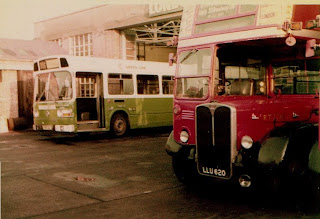
Friday, 31 July 2009

Chapter 18 Return to Hemel Hempstead 1979


It was good to be back and my entrance into the canteen was warmly welcomed by my ex Tring colleagues and those older Hemel drivers who remembered me from some years earlier.
Both routes and management had changed since I had last worked at Hemel. The kindly father figure of Chief Inspector Reg Goodchild had been replaced by Chief Inspector Arthur Harris. Unlike Chief Inspector ‘Jerry’ Coe who welcomed me to Amersham with a smile and a hand shake, the first time I saw Arthur Harris was on my first discipline. I was most put out that the Chief Inspector could not be bothered to see me and welcome me to Hemel Hempstead and I told him so when I went in for that discipline.
I did not do any route learning as the long distance route like 330 to Welwyn Garden City and the 347 to Uxbridge had not changed. The town service had been revamped to one man operation but for this I just opened up the map in the timetable and followed that around the town. After awhile Hemel Hempstead became more familiar to me than my home town of Aylesbury. After two years away it seemed strange to be driving over the routes I first encountered on my return from Australia.
Although I was not officially due to start at Hemel until the Monday, due to their staff shortage of coach drivers, I was asked by the duty inspector at Amersham if I would care to work my rest day on the 708 Greenline to Victoria on the Saturday. Well I knew the route so why not.
No one had told me that from October 1977 the 708 went via Brent Cross Shopping Centre.
I turned left at Staples Corner and was completely bewildered. Fortunately one of our bus drivers, ‘Lofty Price’, was on board. “Hey Lofty give us a hand, show us the way into Brent cross will you” Lofty came and stood beside me, soon we were both lost. “Talk about the blind leading the blind” called out one of our passengers who then proceeded to guide me into Brent Cross shopping Centre.
Originally both the 708 and the 706 used to go along the Edgware Road via Cricklewood and Kilburn. At the end of Kilburn High Road was a Zebra crossing and with people crossing all the time delays were becoming more and more frequent. To help speed up the journey times all coaches were now sent along the North Circular to turn right onto Hendon Way and then right onto the Finchely Road. Ironically just after this new routing was instigated pedestrian lights were installed on the crossing in Kilburn solving the long hold ups.
Now all shopping centres are horrendous for traffic especially on Saturdays and Brent Cross was no exception. It reached the point where it was taking as long to get into and out of Brent Cross as it was for the rest of the journey to Victoria. Management then wisely stopped the coaches going into the shopping centre and instead had us stop close by on the North Circular Road.
Over time most routes have minor changes to them because of new housing estates or new railway forecourt developments. One day while still at Tring I was asked to work a rest day at Hemel Hempstead on route 330 to Welwyn Garden City a route I had driven over with Routemasters when I started there in 1972. Hemel now had RMCs on this route, a Routemaster which had doors at the rear. I met the conductor in the conductors room and said I should be ok even after a few years away from the route. After leaving Hemel my first stop was up near Bennetts End Road. I pulled up and waited for the passengers to get on. I could see them in my nearside mirror and wondered why they were not boarding when I heard a tapping on the saloon window behind me. The conductor was frantically waving his hand about and pointing at some buttons beside my right hand. On close inspection I saw these were door operating buttons. Well I didn’t know only the driver could open the rear doors on the RMC although the conductor could close them. After that hiccough I continued all the way to the terminus at the QEII hospital at Welwyn Garden City. Climbing down from the cab I went back to see the conductor and said “well I found the way ok after all this time.”
“Nearly mate, except you missed out St Albans railway station, why do you think I was waving left as we went over the bridge.” I had thought he was just reminding me to bare left at the end of the road. Unbeknown to me St Albans city council had built a bus and rail interchange at the station which we now serve by turning into the station, well not on that journey we didn’t.

Friday, 24 July 2009

Chapter 17 Greenline comes to Amersham


As I had mentioned earlier when I arrived at Amersham there were no Greenline services but that was now about to change. It was decided by the powers that be that a new service, the 790, should run from Amersham via High Wycombe and Uxbridge to Victoria. I had missed the Greenline coaches and applied for a position on the new rota. Not many of the Amersham drivers wanted the hassle of driving into London so the majority of the coach drivers on the new rota were ex Tring drivers. Soon a brand new Duple bodied AEC Reliant appeared in the yard ready for type training. Unfortunately the driving school were in dispute with management and were refusing to undertake any driving instruction. However mindful of public safety the Chief Driving Instructor Mr Durelli took it upon himself to allow us cab training. This meant we could sit in the cab but not start up the vehicle and we could familiarise ourselves with the controls. We were however each given a handout showing us all the various controls.
Fortunately we had done route learning although in an MB bus. I remember pulling away from Victoria with the Inspector who was showing us the route saying to the rest of the drivers, now watch how David does this as he is an experienced coach driver, that was a feather in my cap.
The first day of operation, a Monday, was a damp foggy day. Mr Durelli had decided to travel with each driver between Amersham and High Wycombe so
that the drivers could sort out any problems before continuing to London. With the passengers already on board I made myself comfortable at the wheel and proceeded to get out the hand out and in full view of the passengers and set about starting up the coach and turning on the lights. At this point I turned to Mr Durelli and said “Where are the fog light switches”? much to the amusement of the passengers. Equally amusing was Mr Durelli’s reply, “I don’t know, I don’t even know if this coach is fitted with fog lights, I’ll get out and have a look” As it happened there were no fog lights and therefore no fog light switches. The fog soon lifted and I really enjoyed driving to Victoria. Driving into Uxbridge brought back many memories, of my time there when Annette and I were first married and to see on occasions Hemel Hempstead drivers on the 347s from the days back in 1972when I first started at Hemel garage. It was a pleasant drive to Victoria and back and two trips a day were not too arduous.
There is always an exception to the rule. Throughout my driving career Annette has always come out for the odd ride or two when I’ve been driving and we thought it would be a nice ride out for her and the children if they all came for a ride with me to London and back. Mark was five years old and thoroughly enjoyed himself, Heather who was a one year old did not. We pulled into Uxbridge and Heather was crying for a feed so to help Annette I held her on my lap at the steering wheel and fed her a bottle. But soon after departure Heather was crying again wanting to get on the floor, and then back on Annette's lap and then on the floor again, her nice clean clothes getting dirtier all the time. After an hour of crying and playing up we finally arrived in Victoria where she received a smack on the bottom for misbehaving and promptly fell asleep for the return journey. Even the revenue Inspector, Bob Gilbert, who boarded the coach just as we left Victoria remarked on how well behaved both children were.
We were now entering the era of efficient management. This in reality meant more work for the same pay for the drivers. One of the casualties was the Greenline workings. To make it more efficient the drivers were to work less hours and get paid less. This appealed to some of the older drivers but with two children and a mortgage I could no longer afford to stay on the Greenline. So back to bus work.
I mentioned earlier when Tring closed six drivers transferred to Hemel Hempstead and six of us transferred to Amersham. With the alteration to the coach rota three of the drivers left. Soon another driver transferred to Hemel Hempstead. After a while I found I was the last driver from Tring at Amersham. What with no Greenline work and the feeling that most of my former Tring colleagues were at Hemel Hempstead I decided to transfer to Hemel Hempstead, the garage I started at upon returning from Australia.

Saturday, 18 July 2009

Chapter 16 Who is watching over you?


No matter where or when, there is always someone watching you. Most of the time it is uniform inspectors. The first time I encountered this phenomena was the Gold Badge Inspector who boarded my bus when I was training back in 1967. There was no excuse for not knowing about being observed, you were told in the driving school that either plain clothed or uniform inspectors would check your driving during you first few months. I was driving the 706 Greenline from Chelsham, when arriving at Croydon, Mr Durelli the Chief Driving instructor boarded my coach. Well I considered my driving up to scratch and continued driving forgetting all about Mr Durelli sitting at the back. However whilst sitting at the traffic lights on Streatham Hill Mr Durelli came forward and informed me that since he had boarded at Croydon I had not once engaged neutral gear. Oops, even with a pre-select box you are supposed to engage neutral when standing for any length of time. I have since discussed this with engineers who actually differ with this line of thought saying it puts less strain on the gear box if it is left in gear.
I have already mentioned being caught out by Inspector Ron Wright who happened to be on duty at midnight at Tring and booked me for running four minutes early. I imagine I have had my share of plain clothes revenue inspectors board my bus but I suppose my driving and issuing of tickets must have been ok. There have been many times when passengers have, after sitting down, come back to me and told me I did not give them a ticket. This is often said with inference that I had pocketed the fare. My usual response is to ask them if they had taken their ticket. I then get up and check all the passengers tickets and sure enough you will find that the passenger complaining had not taken their ticket and the following passenger, without bothering to check their ticket, has taken two tickets much to the chagrin of both passengers.
Well who checks the Inspectors, well somebody does. There was an Inspector at Amersham who had a side line in a taxi service which would have been ok if he had kept this side line to his off duty time. However he would often inform the office that he was just popping out to do
a bit of checking but would go and do a little bit of taxi work. Someone must have got wise to this and one morning whilst on duty, he received a call to go and pick up someone at Chalfont and Latimer Station. Unfortunately the passengers to be picked up were company officials who had made the phone call. Result, instant dismissal.
There were occasions when doing a second job could prove to be handy. One driver also had a hand in running a private coach company. During a period of severe fuel shortages (I cannot remember the reason for this) his company had fuel to spare and we ended up ferrying our buses over to his depot to fuel our buses, a very nice little earner for him. I cannot see to-days management agreeing to anything like that to keep the buses running.
Someone at Hemel Hempstead should have been keeping an eye on one of our inspectors (I will not mention his name but many will remember the incident). Part of the yard was being replaced and the contractors had left a compressor in the yard over the weekend. On the Sunday morning two workers turned up and asked if the inspector could move a couple of buses so that they could remove their compressor as they needed it for another job.
Red faces all around when on Monday morning the contractors turned up and asked who had stolen their compressor. Yes poor old Inspector ****** had helped a couple of thieves take away the contractors compressor.
Why was the yard being replaced? Well water used to wash the buses use to run down the yard and out into the road. To stop this concrete ramps were placed across the bottom of the yard. Over a period of time the ramps became worn with the iron reinforcement poking through. One dark evening one of our drivers was walking down the yard with his ticket machine box under one arm and his cash tray under the other. Catching his foot on the broken ramp he fell down and tore both ligaments on his shoulder.
Now how the company thought they could get away with not admitting liability I don’t know why but they tried. The first thing they claimed was that there were no ramps there in the first place. Fortunately another drivers had been taking photos in the yard the day before which clearly showed the ramps and the condition they were in.
After a long time and many solicitors letters the company finally admitted liability and our driver received compensation for his injuries. As I said someone must keep an eye on the watchers.

Friday, 10 July 2009

Chapter 15 Amersham Garage


Monday 3rd April 1977 saw myself and five other Tring drivers assembled in the canteen at Amersham garage. We didn't feel out of place for too long with many of the Amersham drivers coming over to our little group and introducing themselves. A few minutes later in came their Chief Inspector ‘Jerry’ Coe who introduced himself with a warm smile. Jerry explained to us that as well as route learning all of us would have to take another full PSV test so that we could drive the Bristol BN buses that served Amershams’ rural routes. My greatest disappointment on transferring to Amersham was to find that although Amersham had taken over most of High Wycombes bus routes there was to be no transfer of its Greenline route, 711 High Wycombe to Victoria. Amersham had lost its own Greenline service 710 Amersham to Baker Street on the 13th October 1972. At that time the need to regain my full PSV was more important than going back on the Greenline.
Rather than take a new test on the current Bristol BN, a short bus, it was decided that we should be tested on a full length vehicle. To our surprise it turned out to be a Harrington bodied vehicle used on coach tours with panoramic sky lights and an entrance door set back from the front of the vehicle. Our instructor had had two weeks to go before his retirement and had the unenviable task of getting six drivers, who over a number of years had become set in their ways, through a full PSV driving test. A full day was used just to become accustomed to driving a vehicle with a crash gear box. Then when we were asked to perform a gear box exercise a deathly hush descended up the bus. “Have you never heard of a gearbox exercise?” No one had, and so began the slow process of finding a very quiet road and driving up and down it first changing up through the gears and then changing down through the gears, a long and arduous task, remember this coach had no synchromesh gear box. Eventually we got the hang of it and then proceeded on to the finer points of driving, like continually checking mirrors and reversing. Each time I’ve taken a PSV driving test, and this was to my third, the procedure for reversing has been different. Some times you had to reverse using mirrors only, at other times you were allowed to look out of the cab when reversing on the offside. This time when drivers were having difficulties in reversing the instructor told them to poke their head out. “Ah so it’s ok this time then”
So a week later I found myself back at the training school in St Albans garage, remember RF training five years earlier? To day global warming is in the forefront of weather conversation, well I have noticed that over the years the winters have become much shorter, but it was no surprise to me to find it snowing a couple of weeks into October 1977. Amongst us six drivers from Tring we had to decide who was going first and whether the snow was going to ease up or get thicker. I opted to go first. With the snow settling fast I was glad to get the gearbox exercise and the emergency braking over with early on in the test. Putting my head out during reversing had its own problems, I didn’t want my glasses getting covered in snow. After about forty five minutes I arrived back at St Albans to be questioned on the Highway code and to be told I’d successfully past my test. I had now regained a full PSV license.
Back to Amersham and back to driving buses. Apart from the 353 Berkhampstead to Windsor, the 305 Uxbridge to Chesham and the 336 Watford to Chesham all the other routes at Amersham were short distance routes serving small villages around Amersham such as Lee Common, Ballinger, Chesham Moor and Missenden. Then there were all the routes that Amersham had absorbed from High Wycombe. These were mainly High Wycombe town service routes. I believe it was these routes that finally drove me to return to Hemel Hempstead two years later. A lot of the duties at Amersham consisted of dead running (out of service) to High Wycombe bus station and then spending the rest of the day going in and out of High Wycombe bus station each time on a different town service, which meant each time you came into the bus station it was at a different stop from which you had left, very confusing for both driver and passengers whenever I got it wrong which was quite often.
A prime example of getting it wrong was on route 362 High Wycombe to Chesham. In the evenings we would bring back a group of ladies who had been to bingo in High Wycombe. The A404 is a long fairly fast road between High Wycombe and Amersham and I was driving along at a good pace when all of a sudden the bingo ladies all called out “Hey you’re one of those new Tring drivers” “How do you know?” was my reply. “You’ve just gone pass the turning for Holmer Green like all the other Tring drivers”. Fortunately I was able to take the next left turn and go through Holmer Green the wrong way round.
The journey on my motor bike between Aylesbury and Amersham took about twenty five minutes and was through lovely countryside. Unfortunately coming home late one night along the unlit Missenden by-pass I met one of the hazards of the countryside. Driving along in the pitch dark all of a sudden in the head light there appeared a solid wall of brown cow hide. As I hit the cow my motor cycle windshield shattered, then my crash helmet visor shattered then finally my glasses, my bike and I went sailing through the air. Fortunately I had a soft landing on the grass verge. When I recovered consciousness I wiggled my hands and toes and found nothing amiss but then my ears detected the movement of big hooves and mooing all around me, Oh no don’t tread on me cows. Eventually I managed to get to my somewhat shaky legs and look around. Not much to see as it was very dark. Then I saw a police car coming along, the police driver never saw the cows either and ended up coming to rest up on an embankment with a bent police car and torn trousers. He came across the road to help me and to call for an ambulance, which I declined. He called his colleagues for assistance and soon we saw another police car coming along in pursuit of another car and using his blue light and flashing his headlight to try and warn the car of the bovine obstruction. Again to no avail, this time the lady driver found the cows to be tougher than her car which had all of its nearside wing taken off. Having located my motorbike and straightened the steering out the police officer asked if I’d be ok to drive it home. I said I’d be ok but could he ring my wife to let her know I could be a bit late, (no mobile phones in1978). When I finally arrived home instead of finding Annette waiting to comfort me and attend my injuries I found she was asleep in bed. Apparently the message she received from the police officer was that I was helping the police with a traffic accident which Annette had interpreted as there had been an accident in which I was not involved but I was in some way helping them as a witness. After this minor misunderstanding I was soon being comforted. It was not until the morning that I soon found how bruised and sore I was. The motor bike had a dented fuel tank where my right knee had hit it and the headlight had cow hide embedded in it. When I took the bike in for repairs the mechanic diagnosed my injuries from the state of the bike. My right arm and shoulder would hardly move and my right knee was badly bruised as were both my eyes and face. Annette joked that it looked like she had been hitting me about. My Doctor advised me to take a couple of weeks off but as we did not get paid for the first three days of any sick leave it was imperative for me to get back to work. So after only a couple of days off, during which my children would not look at me because of the state of my face, I went back to work. Fortunately I was able to borrow my mothers’ car whilst my motorbike was being repaired. Unfortunately I was unable to claim any compensation for the repairs to the motorbike or myself as, even with the help of the police, I was unable to trace the owners of the cattle. The police told me the day after the accident that if any of the cattle were injured they would have been taken to be slaughtered straight away. It was too dark that night to follow the cattle and they would have gone back to the fields from which they had escaped.
Although feeling pretty sore I convinced Mr Coe the Chief Inspector that I was fit to drive. Well I thought I was until I drove into High Wycombe bus station. As you drive down from the road into the bus station you put on the saloon lights and on the MB type buses this requires the driver to stretch his right arm up to the switches above his head, and my arm just wouldn’t move up. Once in the bus station I had to stand up in the cab and put the lights on, needless to say I left them on for the rest of the duty.
Breakdowns as I said earlier were a rare occurrence but as newer vehicles replaced the reliable RT, RM and RF breakdowns became more frequent. Vehicles were no longer purpose built as was the RM for London traffic, with the crew in mind, and the RT although slow could climb almost any hill. The new AEC Swifts and Merlins had a tendency to overheat when shown the slightest incline fortunately when the overheat warning buzzer became to annoying it could be turned off from a switch in the cab, this was ok as the water temperature would revert back to normal when going back down hill. However if the temperature increase was due to low water or even a leak then with the warning buzzer turned off disaster was inevitable. But even so the mechanics at Amersham were nothing if not resourceful. Whatever the breakdown they would come fully prepared with a wooden mallet and a screwdriver, and get the bus going again. I’ve had a bus stuck outside Amersham garage with a jammed starter motor, a screwdriver to open up the access panel in the saloon, a hefty whack on the starter motor casing and the screwdriver to short circuit the starter and off we'd go again.
Bad weather was always a hazard of driving, whether it was torrential rain, fog, snow and ice we would always try and get through. One of the strangest weather phenomena I came across was one morning whilst driving a BN (Bristol crash gear box bus) in Amersham. It was about nine o’clock in the morning and I pulled up near the kerb, a foot away perhaps, pulled the hand brake on and selected neutral when the bus just slip sideways into the kerb. People were slipping over everywhere. It had up until then been a mild damp morning then there was a very sudden drop in temperature causing both roads and pavements to become covered in a fine film of ice. Driving back to the garage was quite a feat. When I got home later I told Annette about it she said she also had problems, she had to hang onto the pram whilst taking young Mark to play school otherwise she and Mark would have fallen over. Within the hour the temperature had risen and all was well again

Friday, 3 July 2009

Chapter 14 Closure of Tring Garage


As 1977 approached we began to hear ominous rumours of impending closures, but it couldn’t be Tring, surely not, the painters had just finished painting the whole garage. Ah don’t be fooled by those clever management techniques. We were called to a union meeting in the local village hall where it was announced that the Union had done all it could to avoid the closure of our garage but unfortunately the county council had to keep control of subsidies for public transport and Tring garage would close on Friday 31st March 1977.
Drivers and conductors were given the option of redundancy with appropriate payment or relocation to another garage with a disturbance payment for two years or help with house moving to another location near to a garage of your choice.
I believe all the conductors took redundancy. Of the drivers only twelve chose to remain with the company. Of the rest some drivers took redundancy and a few took early retirement. One driver however was very fortunate and that was Johnny Herculese. John who had taken me route learning on the 706 some five years earlier decide to take his redundancy money, and join the local Aylesbury bus company Red Rover. A few years later Red Rover were bought out by the major bus operator in Buckinghamshire, United Counties, When the eighties arrived and bus companies were being sold off at knock down prices United Counties became Luton and District under a management buy out. Time moved on and Luton and District took over what had been London Country North West. LCNW was of course operating the 301s out of Hemel Hempstead, and John was working out of Aylesbury. Luton and District being the main controlling company saw fit to transfer some of Hemel Hempstead 301 workings to Aylesbury. And so it came to pass that many years later I would pass John, smiling away, driving the same 301s he’d been driving at Tring.
As the fateful day approached we were interviewed by management with a union official present and asked to make a decision on our futures. I had already decided I wanted to stay with London Country, but I did not know whether to transfer to Hemel Hempstead, Amersham or High Wycombe. During the last week rumours had been flying around that either Amersham garage or High Wycombe garage was also to be closed. At an early morning meeting with management and a T&G 0fficer, we as drivers pointed out that it was no use transferring to either Amersham or High Wycombe only to find ourselves in the same position a few weeks later. We were told that management would get back to us after mid day.
By mid day, due to our pressure, High Wycombe garage learnt of its fate. High Wycombe was to close on the last day of the following September, six months later. How long this information would have been withheld from the staff is any ones guess, but at least it was now clear to us Tring drivers, we had three choices, Hemel Hempstead, Amersham, or redundancy.
Both garages were the same distance from my home in Aylesbury, 15 miles, a journey time of about twenty five minutes on a motor bike. The main incentive to transfer to Amersham was that Amersham operated the Bristol BL buses which were crash gear box vehicles.
As I has said earlier upon my return to the UK the Traffic Commissioners had made the obtaining of a full PSV licence only possible to those drivers who had passed their tests on a crash gear box vehicle. As I had taken my second test on an RT pre-select gear vehicle I now had a restricted licence. This then was an opportunity to regain a full PSV licence, for it was a requirement of the transfer agreement that all drivers would be upgraded to a full licence.
So papers all signed it was a sad farewell to Tring and all my friends and colleagues. Many drivers chose redundancy and took up other jobs. Two of the depot inspectors, Pete Letissier and Vic Cooper took up positions with London Underground, some took up work with local coach firms, my good friend Ted Goodchild went back to his first love, engineering. Of the remaining drivers six transferred to Hemel Hempstead and six transferred to Amersham. The odd thing was that of the six, including myself, who transferred to Amersham all left within two years, I being the last to leave. Whereas all the six who transferred to Hemel Hempstead stayed until they retired.
A few weeks before Tring closed our second child was due to be born. I wanted to be there at the birth as I was with Mark. So I carefully arranged with the other coach drivers to change my duties so that I would be resting when baby was due. Well baby had her own agenda, a false labour and then at the last minute 'here I come'. I finally changed to the last duty of the day in case baby came during the 27th Feb. But no, there I was at Watford at midnight and baby Heather was born at a quarter past midnight on the 28th.
Fortunately Annettes mum had come over from Australia to help out so when I came home at 1 o'clock mum was there to greet me with the news that I was the proud father of a baby girl. Now as it was late at night and Annette would be resting I thought it would be better to meet the new addition in the morning. Unfortunately Annette thought I would be so thrilled that I'd go and see her baby and straight away, so while Annette was awake waiting for me I was fast asleep. Never mind Mum and I took Mark around to meet his new sister first thing next day.
I was resting on the last day of operation of services from Tring but on that last day, 31st March 1977, I took my wife, our four year old son Mark and our new four week old daughter Heather (who much later accompanied me at another garage closure) along to the garage to say goodbye to all my old friends. The previous evening I had brought my last 706 from Chelsham to Tring, and now it was on to pastures new.

Saturday, 27 June 2009

Chapter 13 Decline


During the seventies there was a steady decline in coach passengers and I believe two things contributed towards this decline.
Green Line has always been there for the long distance commuter. We had many passengers who not only travelled from Aylesbury and Tring to London but many who went on to South London and Croydon. It was often the case in the evening peak at Aylesbury that upon pulling up at the departure point you would have to tell waiting passengers that you could only take those travelling to Berkhampstead and beyond, any one else would have to board the 301 bus which duplicated our route as far as Watford.
Because of falling revenue Watford council came to an arrangement with London Country which allowed old age pensioners in Watford to use their passes to obtain half fare travel on the Green Line coaches towards Hemel Hempstead and Aylesbury. We managed to keep to time all the way from Croydon to Watford, making sure the 142 red bus was in front of us at Stanmore Station as local bus passengers would grab a coach ride up to Bushey Heath given the chance. With a full load on by the time you had climbed up to the Alpine Restaurant at Bushey Common the cab would resemble a sauna with steam from an overheated cooling system pouring into the cab. Now we were severely held up by many old age pensioners getting on the coaches and of course being older and slower we would then lose time to Tring. Some would use the coaches for the longer journey to Hemel Hempstead or Aylesbury, but many would use the coach for shorter journeys instead of getting the local buses, therefore our punctuality began to suffer.
The second major cause in the decline of patronage was the introduction of the Leyland National bus. This mass produced cheap fit all bus was intended to replace the aging RT fleet. It was a very innovative bus and quite unlike anything we had ever driven before, it was a very noisy bus and should never have been placed onto Green Line coach workings. It had hard plastic covered seats and only by sitting at the back of the bus could you get a decent view, however if you sat at the rear of the bus you couldn’t hold a decent conversation because of the noise from the rear mounted engine. The heating could only be controlled from a panel at the rear of the saloon. I say controlled, it was either on or off, if it was off you froze and if it was on you cooked. People deserted us in droves.
The original Leyland National was 11.3m in length. All of the drivers at Tring had a days instruction on this vehicle under the watchful eye of Bob Spence who was now the Chief Driving Instructor. Of course Bob was quite happy to correct many of the bad habits that we had picked up over the years.
Tring was the second garage to be allocated the Leyland National, and in March 1973 the 706 lost its comfortable RF coaches. So uncomfortable were the LN buses that upon arrival at Two Waters, Hemel Hempstead passengers would ask us if the 708 was due, the RF was still allocated to the 708 at that time, and rather than get on us they would wait for the 708 to London.
In due course some one at the top must have had a twinge of conscious as in October 1974 Tring received an allocation of the shorter 10.3m Leyland National with coach seats installed. This was only a minor improvement to this noisy vehicle. As well as the noise and the heating there were two other odd design faults which would often throw the driver.
The gear change lever was situated on the right hand side of the dash board with the hand brake situated right below the gear lever. The hand brake was fitted with a very sensitive spring and could be applied with very little pressure. The placing of the brake in very close proximity to the gear lever could produce a most alarming and puzzling occurrence when pulling away from a bus stop. Immediately after pulling away you would normally change from first gear to second, a small movement of the hand on the gear lever, unfortunately the drivers hand would then come into contact with the hand brake and the bus would suddenly come to a halt. Wondering what on earth had happened the driver would then see that the hand brake had sprung on, make some spurious comment to the passengers, release the brake and then proceed as if nothing had happened.
The other fault, equally alarming, was the fact that both the hand brake and the gear lever were held on by a small screw and washer, underneath which was a strong spring. After some hours of driving one of the screws would invariable come lose. A loud bang would occur and pieces of hand brake or gear lever sleeve along with screw, washer and spring would go flying around the cab.
The exhaust system was another weak point in the Nationals design. It was prone to snap off. One day I arrived back at Tring to be met by the Garage Manager and a mechanic. “where is your exhaust pipe driver?”
“Underneath where it’s supposed to be”
“No it’s not” they both said “it’s in Cricklewood garage, it fell off as you went past and one of their engineers went out into the road and retrieved it.”
After a while we had at Tring 10.3m Leyland buses some with plastic seats and some with coach seats and also 11.3m Leyland Nationals.
One of the coach duties at Tring was a spread over. It consisted of two trips to London, one in the morning peak and the other in the evening peak. You would also be allocated the same vehicle. Although the 706 normally had the 10.3m Leylands with vehicle shortages it was sometime necessary to allocate a Long Leyland to the London duty. One morning I had gone to London with the 10.3m bus and arriving back at Tring reversed the bus up against the fence in the yard. Later on I returned to do my second trip to London with what I assumed to be the same vehicle, which was parked where I had left it. I duly went to London and back and having arrived back at Tring commenced to reverse the bus up against the fence, only this time I managed to knock down the fence. Some what puzzled I got out, the front end was level with the next coach, unfortunately the back end extended another metre beyond it. During the day unbeknown to me someone had swapped my 10.3m bus for a 11.3m version. I had gone to London and back with out even noticing it, you automatically adjusts your driving to the size of the vehicle, except when reversing it seems.
Mind you I was not the only driver who had problems with the Leyland National. Both the RT and the RM had flat windscreens whereas the Leyland National had a slightly protruding curved screen. With the RT and RM in heavy traffic we would always pull up tight to the bus in front, this way you could lean out of the cab and chat to the clippie on the platform of the bus in front. Unfortunately my friend Johnny Hercules had forgotten this and proceeded to pull up tight to the rear of a 109 bus outside Streatham garage and much to his dismay saw the windscreen slowly disintegrate in front of him. We soon learnt to leave a little bit more of a gap between us and the bus in front.
Being mass produced and cheap it was very light. This was self evident one evening when coming back to Tring garage one night during a very fierce storm. Approaching Tring I could see a large tree had blown down right across the road. The only way to reach the garage was to go along the by-pass and approach the garage from the Aylesbury side. I explained this to the passengers and set of down the rather exposed by-pass. Whenever I encountered a sudden gust of wind the whole of the front end of the bus would lift off the ground leaving the steering useless. This was a very scary experience and something manufacturers should bear in mind when manufacturing rear engined vehicles.
As far as vehicle allocations to the Green Line was concerned the best was yet to come. As the 301 bus route had been converted to one man operation in May 1975 we had spare conductors and conductresses and so in June 1976 RT3530 from Garston garage was allocated to Tring and was put on the 706 spread over duty covering the two peak journeys to London. This wonderful double deck working lasted from June 1976 until February 1977. RT 3530 returned to Garston in September 1976 but we were lucky enough to get RT3631 from Luton to replace it.
Although different drivers worked this duty as it occurred on our rota the same conductress worked this duty all the time and this was Peggy Williams.
Being a spread over duty meant that you would get paid from sign on to sign off and that meant twelve hours pay so for Peggy that became a nice little earner. But for us coach drivers working with Peggy could have its moments.
Having worked with Peggy before as I have already mentioned earlier I knew she was a bit dizzy but this one time really sums up how dizzy she was.
Peggy’s husband David was a driver at Tring and this particular day David was on a late turn and Peggy and I were on the 706 to London. She told me she wanted to stop somewhere and get something for David’s supper. When we arrived at Cannons Corner between Stanmore and Edgware Peggy came around to the cab and said to me,
“I’m just popping over to the shops to get something for David”
A few minutes later she came back with a very puzzled look on her face,
“The man in that butchers shop didn’t half give me a funny look when I asked him for some ham for David’s supper”
“Peggy, look at the name over the shop will you, J. Silvermans, it’s a Kosher butcher, they are Jewish and Jews don’t eat pork”
Poor Peggy a heart of gold but not wise to the world beyond Tring.
Double deck operation of the 706 spread over duty continued until February 1976 and I was fortunate enough to be rostered to cover the last morning trip to London, we had a full bus and were met at every road junction by hoards of photographers who would jump in their cars as we passed and chase us until they reached the next vantage point.
An advantage of the spread over duty was that the driver or conductor was paid from sign on until sign off. That meant about twelve hours pay although one would only work four hours in the morning peak and four hours in the evening peak and have a break of four hours. At Tring as in other garages the same duty would be worked for five days. So you would work five days of the same early turn then two days rest would be followed by another five days of a late turn then following two days rest one could work five days of a spread over. This system meant that every few weeks one would receive a very good pay packet. The schedules representative at Hemel Hempstead, Vic Edwards (later to become the Chief Driving Instructor) following representation from the drivers asked that the week of spread over duties be broken up so that the weekly pay would be more equal yet slightly higher. As a legal 10 hours rest was required between duties it followed that if a spread over duty was worked each week then you would commence the week on an early turn then move to a middle turn then a spread over duty followed by a late turn with rest days no longer consecutive. This made for a very disruptive working life style and we at Tring wanted none of that and voted to keep our old system. Many years later when privatisation came in and money took preference over all other considerations spread over pay was done away with and now we work different shifts every day.

Friday, 19 June 2009

Chapter 12 Depot Inspectors and Paying in


Ron Wright was a very dedicated Inspector, even to the extent of booking me for running four minutes early into the garage at midnight. Most inspectors would have gone home hours earlier, not Ron. One time the schedules had been misprinted and rather than have us work the incorrect schedules Ron stayed at the garage into the early hours writing all our schedules out by hand for the next morning.
When I started at Tring the Depot Manager was Charlie Hall and the Depot Inspectors were Dave Davis and Vic Cooper. Dave was once a coach driver who was promoted to Depot Inspector. I still enjoyed driving and asked Dave why he had come off the road. His reply was that when I had been driving as long as he had I’d want to come into the office. Well after forty years I still enjoy driving.
Charlie the Depot Manager was always nice to you if he wanted you to do overtime or come in on your day off to work your rest day. Other than that if you wanted Charlie he was likely to shut the window between the office and the conductors room and ignore you.
All money paid in at the end of a duty had to tally with the read out on your ticket machine. In the case of crew operation the ticket machine was the Gibson whereas the coach drivers machine was a six band Almex. This had six rows of levers the first two were green for the fare stage a yellow band for the pounds and two more green bands for the pence and a final red band for the ticket type. Leaving Tring early one morning for Aylesbury and being half asleep I started of by setting up the fare band as the Tring fare stage 68 and then proceeded to sell passengers 68p tickets instead of the correct fare which to Aylesbury was 30p. Fortunately by the time I’d got to Aston Clinton I realised what I had been doing and had to withdraw a lot of tickets valued at 68p and reissue ones of the correct fare. That could have cost me quite a bit when it came to paying in had I not noticed my mistake.
Even to this day the travelling public still believe the company issue us with a float. They never had and never will do. ( A year ago in 2005 Hemel coach drivers were given the option of accepting a £20:00 float on the condition that failure to pay in the exact amount of takings shown on the ticket machine would result in discipline being taken against the driver. Needless to say I refused this offer and continue to carry my own float). It is often a constant battle to find change for passengers who so often do not bother to find the correct fare. In the days of London Transport and even later if a passenger did not have the correct fare and if the driver did not have change the passenger could elect to send their fare into the bus garage by filling in an unpaid fare form. This procedure was always avoided if possible because of the time required to fill in the form one half given to the passenger with details of the fare due and journey undertaken the other portion filled in by the driver and given in to the garage at the end of the duty.
However after a week with the same passengers boarding at Bushey Heath and not having the correct fare I had had enough. On one particular morning every one received an unpaid fare form. Needless to say there were plenty of moans and groans and we were of course quite late getting to Stanmore and all points to Victoria, but low and behold next week they all turned up with the correct fare.
Some times of course the tables are turned and the passengers not only have the correct fare but it will be in lots of pennies or five pence coins. It was often the custom therefore to bag up lots of small coins in small paper bags, blue ones for fifty pence of copper and beige bags for silver. I had the habit of also putting fifty pence pieces in copper bags and putting them in my ticket machine box already to pay in quickly at the end of my duty. One afternoon I was due to finish at Tring garage. I pulled up at Tring Rose and Crown and a young girl got on with a pound note for a 25p fare. Thinking I’ll teach you, I gave her all small change including what I thought was a blue bag containing fifty pence of copper. Imagine how I felt when I went to pay in to find I had given her a bag of fifty pence pieces instead, £10:00 worth. I told the other drivers what I’d just done and one of them, Kenny Edmonds ran out to his car and chased after the coach and waited for the passengers to alight at Bedgrove where the young girl had asked for. Unfortunately for me it would appear she had got off earlier. I’d learnt the hard way, don’t try to be clever and keep a careful eye on the companies money. Charlie Hall the Depot Manager was full of sympathy and said I could soon make up the loss by doing extra overtime. Ten pound may not seem a lot to day but in 1975 my take home pay was about £50:00 so I had just given away 20% of my earnings. I felt really sick and was dreading what Annette would say when I got home. However she realised how bad I felt and was very sympathetic and said we would manage somehow, I knew we would have to cut back on food that week. Charlie true to his word did find me plenty of overtime and I managed to restore the £10:00 to the housekeeping. In fact I did earn a bit more than that and gave the extra to Annette as a thank you for her understanding.
With some of our regular passengers if we didn’t have the change they would either tell us to keep the change or say they will collect it the next day. One of our regulars an elderly lady known only to us as ‘aunty handbag’ travelled regularly from Tring to Marble Arch. So as not to forget her change I wrote on her ticket the amount of change I owed her. It was not until a few weeks later that I was called in to see our Chief Inspector Reg Goodchild. Reg was in charge of both Hemel Hempstead and Tring and would come over to Tring every couple of weeks to hold disciplinary hearings. Reg asked me if I remembered writing on a ticket. When I replied that I did he said “well lad you better go and pay that change in as I’ve just had to pay Mrs **** out of my own pocket.” Apparently on the way home from work ‘aunty handbag’ had asked a driver for her change. He told her he couldn’t do that and she had better call into Hemel and see the Chief Inspector with her ticket and this she did.
Sometimes our passengers were much more appreciative of our efforts. One such was Olive Pepperdine. Olive used to travel every day from Berkhampstead to London. Many passengers were by now buying weekly tickets. These were issued to the drivers by the depot inspector to be sold to the individual passenger. Every Monday Olive would purchase her ticket from the driver at Berkhampstead. One morning I had Olive’s ticket but no coach, a rare mechanical failure. Knowing Olive would be waiting for her coach I caught a 312 bus from Tring to Hemel Hempstead and on arriving at Berkhampstead called out to Olive to board the 312 were I gave Olive her weekly ticket and advised her to travel on the 312 to Hemel Hempstead and then transfer to the 708 Greenline coach to London. Olive always remembered that little bit of help and would always ask after my family even into retirement when I would occasionally see her in Berkhampstead.
Earlier I had mentioned that the Chief Inspector who controlled both Hemel Hempstead and Tring was Reg Godchild. Reg was a somewhat fatherly figure who kept an eye on both his drivers and his garages. One wintery morning we were told the snow was so heavy that we had to terminate at Victoria. Approaching Berkhampstead with a full load of passengers and by now running quite late because of the snow we came to a halt outside the Yeovil café. After some time having ceased to move, one of the passengers asked if we would all like some hot coffee, to which the passenger got off the coach and went into the café and bought all the passengers and myself coffee. After another hour we passed Hemel Hempstead and much to my surprise there was Reg clearing away snow from the forecourt of the garage with a large shovel. I have never seen any other Chief Inspector (now known as Garage Manager) before or since clearing snow.